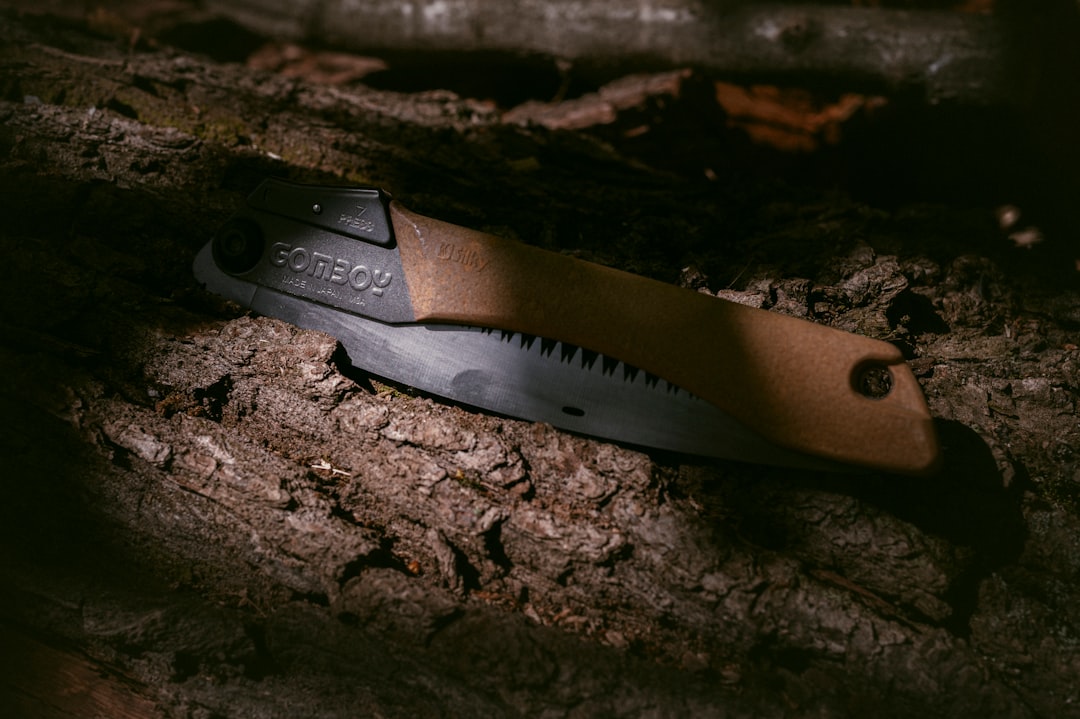
A pruning saw is the tool that quietly settles most of the smaller pruning jobs on a small property. Loppers cannot reach; secateurs are outmatched by anything over about 2 cm in diameter; and a full-sized carpentry saw is both dangerous in awkward positions and wrong for green wood. A pruning saw fills the exact middle band, and it lives in a shed loop or a garden apron pocket for years.
The trouble is that a first pruning saw is usually bought because a specific branch needs to come off this weekend, and the first thing that fits in the shopping basket at the local DIY shop is what gets bought. The result is a lifetime of mild frustration, until you replace it with the saw that should have been the first choice. This is that saw, and the honest logic for choosing it.
Curved vs straight blade: which one first
Curved-blade pruning saws cut on the pull stroke and self-clear as the blade retracts. That means less binding in green wood, less physical effort, and less risk of the saw sticking in a half-finished cut on an awkwardly-oriented branch. For overhead work, one-hand work, or anything you are cutting above shoulder height on a step-ladder, curved is the safer default.
Straight-blade pruning saws (which usually also cut on the pull stroke, but not always) are quicker for horizontal cuts on a bench and preferred by some for larger, dead wood where a longer straight cut across a flat log is faster. For a first pruning saw on a small property, buy curved.
Folding vs fixed: the honest trade-off
A folding saw sits in a coat pocket, a tool belt, a rucksack, or a raised-bed apron with no sheath needed. The blade locks closed for storage and open for use with a lever. It is safer around children, less likely to be misplaced (because it lives in your pocket, not on a shelf), and easier to travel with.
A fixed-blade pruning saw with a sheath is faster to deploy for a session of five or ten cuts in a row and typically has a slightly longer, stiffer blade for larger branches. It is the tool of a professional gardener; a small-property owner rarely cuts enough at once to notice.
Our default recommendation for a first pruning saw: folding, curved, around 18 to 21 cm blade length.
Blade length and tooth pattern
Blade length matters more than most first-time buyers realise. A very short blade (under 15 cm) needs many strokes to cut through anything over 3 cm, which is tiring and pushes the user toward larger, heavier saws for the next branch. An overly long blade (over 25 cm) is unwieldy in a raised-bed corner or against a fence.
Teeth-per-inch (TPI) is the second variable. Modern high-quality pruning saws use impulse-hardened, triple-ground (or triple-bevelled) teeth in a pattern of roughly 6 to 8 TPI. That is deliberately aggressive: it removes green wood in coarse fibres rather than fine sawdust. If a saw advertises “fine finish” or 10+ TPI, it is designed for dry timber or joinery, not living branches.
Handle, grip, and glove compatibility
A pruning saw handle is used with a full-hand grip, usually gloved, sometimes while the other hand steadies a branch. Rubberised, oval-section handles with a slight forward hook shape (Silky, Bahco, Wolf-Garten patterns are typical) fit most adult hands and let you keep pressure on the pull stroke without slipping. Straight, dowel-style handles look tidy but slide out of a wet glove within an hour.
If you sometimes work in cold weather with heavy gloves, size up the handle rather than the blade. Handling a bare wooden handle at 2 C for twenty minutes is much less pleasant than the same handle wrapped in shock-absorbing rubber. Cheap saws share three failure modes on this point: soft rubber that peels off within a season, a handle diameter too small for a gloved grip, and a lever mechanism that seizes with the first sap.
Two saws that do most work; and one you can skip
The reliable working pair for a small property, in our shed for years:
- Folding curved-blade pruning saw, 18 to 21 cm. Silky F-180, Bahco 396-JT, or Wolf-Garten RS-P are all excellent examples in different price bands. Cuts branches up to about 8 cm cleanly. This saw does 90 percent of small-property work.
- Fixed-blade curved pruning saw with sheath, 25 to 30 cm. Optional. Only justifies its cost if you cut a lot of larger diameter wood (5 to 12 cm), like when clearing a hedge or an established fruit tree. Silky Zubat, Corona RazorTooth are working examples. If in doubt, skip it and use a bow saw for the occasional larger cut.
The saw to skip: the compact carpentry-style pruning saw sold as a “garden saw” in DIY shops for under £10. Blunt after four cuts, no impulse-hardened teeth, and a handle that lets a wet hand slip forward onto the blade. The extra £15 to £25 for a proper impulse-hardened saw returns itself in the first afternoon.
Care that keeps a pruning saw alive for years
Impulse-hardened teeth are extremely durable and cannot easily be resharpened at home. When they finally dull, buy a replacement blade (most brands sell them separately at a fraction of the whole-saw cost). Between blade changes, the actual maintenance is minor.
After use, wipe the blade with an oiled rag to lift sap and prevent rust. Never leave a folding saw locked open in the shed with sap on the blade; the pivot will seize. A very small dab of light machine oil on the pivot mechanism twice a year keeps the folding action smooth. Never lever a jammed cut open with the saw; back the blade out and start a fresh cut.
A short honest word on branch size
Any branch over about 10 cm in diameter is out of pruning-saw scope. Above that, use a bow saw or a small chainsaw. Trying to work a 12 cm branch with an 18 cm folding saw is exhausting and gets people hurt. If the branch you are looking at is thicker than your wrist, the right tool is the next size up.
Further reading
Two authoritative resources we recommend if you want to go deeper on this topic:
Frequently asked questions